Nasrid gardens of al-Andalus: history, water and design
Water channels, orchards and courtyards, and a century of romantic reinvention. How to tell documented history from later ideas.
✓ Facts checked on 8 November 2026
Arab, Islamic, Hispano-Muslim, Andalusí, Nasrid: what do the words mean?
| Term | What it means | Caution |
|---|---|---|
| Andalusí | Of al-Andalus, the Muslim-ruled territories of the Iberian Peninsula (711–1492) | Covers almost eight centuries and many dynasties |
| Nasrid | Of the Nasrid kingdom of Granada (13th century–1492) | Only gardens of that period and kingdom are Nasrid in the strict sense |
| Hispano-Muslim garden | A modern label for the gardens of al-Andalus | Historian José Tito Rojo shows the idea was built mainly between the 19th and mid-20th centuries |
| Arab or Moorish garden | Popular labels | Often applied to 19th–20th-century gardens with “oriental” ornaments |
| Islamic garden | Gardens across the whole Islamic world | Not every feature from Persia or India applies to al-Andalus |
A short history of the Nasrid garden
The Generalife was most likely built by Muhammad II (r. 1273–1302) at the end of the 13th century, or by Muhammad III at the start of the 14th; an inscription dates a remodelling by Isma’il I to 1319. UNESCO describes its gardens as including agricultural areas: one of the few surviving medieval examples of agricultural productivity in the area.
After 1492 the gardens kept changing. In 1494 a traveller saw Moorish workers restoring the Generalife; after the expulsion of the Moriscos (1570–1571) surveys recorded severe damage to irrigation, trees and walls, and new gardens followed. In the 20th century, Leopoldo Torres Balbás and Francisco Prieto-Moreno redesigned much of the gardens (the “Jardines Nuevos”, 1931–1951).

The art of water
Water is central: UNESCO lists the artistic use of water and vegetation among the reasons for inscribing the Alhambra and Generalife. A royal irrigation channel, the Acequia Real, carries water to the gardens and the whole complex.
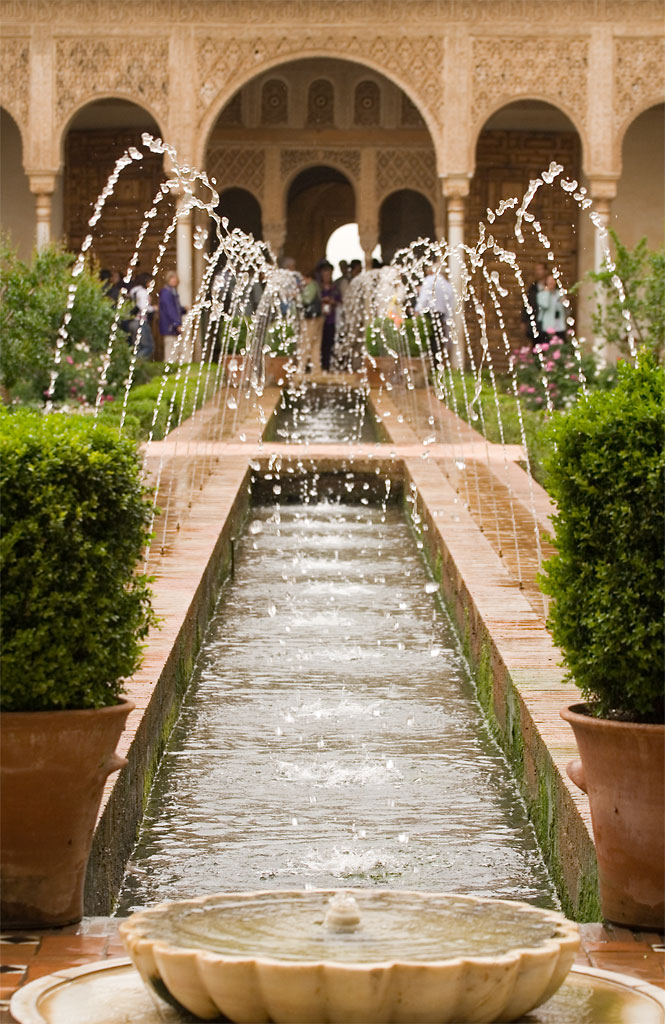
In the Generalife, the Patio de la Acequia (about 12.8 × 48.7 m) is organised around a long channel; its current planting replaces the original on the same four-part layout. The fountains of the Escalera del Agua (Water Stairway) are, according to Casares and Tito, certainly of Nasrid origin, although repaired many times since the 16th century.
The same logic survives in later gardens: in the Jardín Nazarí of Vélez de Benaudalla, a 16th-century garden, an acequia still branches to feed the orchard, pools, fountains and small waterfalls.
Acequias: the irrigation of al-Andalus
An acequia is an irrigation channel, and it is the backbone of these gardens. In Granada, the Acequia Real (royal channel) carries water to the gardens and the whole Alhambra complex; UNESCO counts the artistic use of water among the reasons the site was inscribed.
In the Sierra Nevada and the Alpujarra, the acequias de careo work differently: channels dug into the ground divert rain and snowmelt from the headwaters so that it soaks into the hillsides in winter and spring and feeds springs and rivers later. According to the IGME-CSIC (2025), the practice has been in use since al-Andalus, and the Sierra Nevada has more than 750 km of these channels.
On a village scale, the Jardín Nazarí of Vélez de Benaudalla keeps an acequia of Arab origin that still feeds its pools, fountains and small waterfalls.
Which features are documented?
Channels, pools and fountains
Documented at the Generalife and in written sources; many were repaired or rebuilt after 1492.
Orchard and garden together
Edible, aromatic and ornamental plants were mixed; a vegetable garden was part of the garden, not separate from it.
Raised paths (andenes)
The term appears in a 1526 document about the Generalife; archaeology has confirmed raised paths beside lower planting beds in gardens of al-Andalus.
Myrtle hedges
Tall myrtles described by the Venetian ambassador Navagero in 1526 point to a Nasrid origin; the Patio de la Acequia was first called “of the arraihanes” (myrtles).
Myths to treat with caution
“Every Islamic garden is an image of Paradise”
The Qur’an describes Paradise as a garden, but the idea that earthly gardens were designed as metaphors of it was asserted in the 20th century rather than demonstrated, Tito Rojo argues.
“The four-part cross is always Nasrid”
The famous Court of the Lions had no crossing paths in the medieval period: it was entirely paved in marble.
“Cypress arches and topiary are Moorish”
Such features were often added in the 19th century, for example in Granada’s cármenes.
“A garden called Nazarí is from the Nasrid period”
Names describe a tradition. The Jardín Nazarí of Vélez de Benaudalla, for example, dates mostly from the 16th century.
Where to see this heritage today
In Granada, the Generalife and the gardens of the Alhambra remain the reference. On the way to the coast, the Jardín Nazarí of Vélez de Benaudalla shows how an Arab-origin water system survived in a 16th-century garden estate.
Frequently asked questions
What is a Nasrid garden?
A garden of the Nasrid kingdom of Granada (13th century–1492). The Generalife, next to the Alhambra, is the best-known surviving example, although much of its current planting dates from the 20th century.
What is the difference between an Arab garden and a Nasrid garden?
“Arab garden” is a loose popular label, often used for later gardens with oriental ornaments. “Nasrid” refers precisely to the kingdom of Granada and its period.
What role did water play in the gardens of al-Andalus?
A central one: channels (acequias), pools and fountains irrigated orchards and ornamental beds. UNESCO highlights the use of water and vegetation at the Alhambra and Generalife.
Were Islamic gardens designed as images of Paradise?
This is a common claim, but historians such as José Tito Rojo argue it was asserted in the 20th century rather than demonstrated from medieval sources.
What were gardens like in al-Andalus?
Documented gardens mixed productive and ornamental plants, used channels and pools, and sometimes raised paths beside lower planting beds.
Sources · Facts checked on 8 November 2026
- Tito Rojo, J. (2015), “El «jardín hispanomusulmán»: la construcción histórica de una idea”, Awraq 11
- Casares Porcel, M. & Tito Rojo, J., “El Generalife después de la expulsión de los moriscos”
- UNESCO World Heritage · Alhambra, Generalife and Albayzín, Granada
- Wikipedia · Generalife
- Turismo de Granada (Diputación) · Generalife
- Diputación de Granada · Jardín Nazarí de Vélez de Benaudalla
- IGME-CSIC press release (16 Apr 2025) · acequias de careo in the Alpujarra