Andalusia without mass tourism: authentic places between Granada and the sea
Real villages, protected coves and working markets, and, for each one, the concrete reason it is less crowded. No “secret spots”, just sourced reasons.
✓ Facts checked on 8 November 2026

Where the quieter Andalusia is, and why
The Costa del Sol, in the province of Málaga, takes about a third of Andalusia’s tourism. East of it, the coast of the province of Granada, the Costa Tropical, and the valleys behind it are a different scale: towns such as Motril, Salobreña and Almuñécar on the sea, the Guadalfeo valley along the A-44 inland, and the Alpujarra on the southern slopes of Sierra Nevada.
This page does not claim any place is empty. For each place it names the reason it is quieter: a protected area that limits building or access, a small population, an isolated setting recorded in official beach data, controlled visits, or simply the season. For a full comparison of the two coasts, see our Costa Tropical vs Costa del Sol page.
- Costa Tropical or Costa del Sol?: the full comparison, with sources

Quieter places at a glance
| Place | Where | Why it is quieter (sourced reason) |
|---|---|---|
| Vélez de Benaudalla and the Jardín Nazarí | Guadalfeo valley, inland on the A-44 | Village of 3,108 inhabitants (INE 2025); not a resort and not on the coast |
| Sierra de Lújar paths | Above Vélez de Benaudalla | Village paths described by the town hall; the mines path is not signposted |
| Alpujarra villages (Poqueira gorge) | Southern slopes of Sierra Nevada | Historic ensembles protected as BIC (Bien de Interés Cultural) |
| Salobreña old town | On the rock above the coast | Historic quarter protected as BIC Conjunto Histórico (Decreto 120/2017) |
| Coves below Cerro Gordo | West of La Herradura (Almuñécar) | Acantilados de Maro-Cerro Gordo protected area; Calaiza and Barranco de Enmedio listed as isolated by Turespaña |
| La Rijana and Cambriles | East of Calahonda | La Rijana listed as isolated, Cambriles as low occupancy (Turespaña); Calahonda-Castell de Ferro marine ZEC offshore |
| Charca de Suárez | Motril, near the coast | Reserva Natural Concertada (13.5 ha); closed Mon–Tue, guided visits by appointment 1 Mar–31 May |
Vélez de Benaudalla and its Jardín Nazarí
Vélez de Benaudalla is a working village of 3,108 inhabitants (INE, 2025) in the Guadalfeo valley, at the southern end of the A-44. It is inland, not a seaside resort, and its life does not revolve around visitors: shops, bars, irrigated terraces and a castle, the Castillo de los Ulloa, probably built between 1494 and 1523 and open to visitors since 2003.
Its best-known sight is the Jardín Nazarí, an estate of almost 7,000 m² with a house, a mill, an acequia and small caves in the cliff. It is closed on Mondays and Tuesdays; check the Diputación de Granada page for current hours before going.
- Vélez de Benaudalla: the village, its castle and its walks
- The Jardín Nazarí: opening, history and what you see

The Sierra de Lújar above the village
Behind Vélez de Benaudalla rises the Sierra de Lújar. The town hall describes several paths that start from the main square: the Fuente del Algarrobo route towards the west face of the sierra, the Haza del Señor climb (which it calls “una etapa dura”, a hard stage) and the Sendero de las Minas to the abandoned lead mines of La Raja, El Guano and La Paloma.
Why it is quieter: these are local village paths, not a marketed trail network: the town hall notes the mines path is not signposted, and it publishes descriptions rather than distances or times. That is exactly why you need a map, water and some experience.
- Hiking in southern Granada: trails with their official figures and sources

Alpujarra villages
On the southern slopes of Sierra Nevada, Pampaneira, Bubión and Capileira in the Poqueira gorge are protected as historic ensembles (BIC), within the setting of the Sierra Nevada National Park. That legal protection is the concrete reason: the historic centres, with their flat-roofed houses and narrow lanes, are protected heritage.
Honest note: the Poqueira villages are the best known in the Alpujarra, so “quiet” there depends on the day and the season. Trails link the villages, which is the most relaxed way to see them.
- The white villages of the Alpujarra: Poqueira gorge, Trevélez, Lanjarón and Órgiva
Salobreña old town
Salobreña’s historic quarter (the walls, the Nasrid castle and the Tajo) is protected as a BIC Conjunto Histórico (Decreto 120/2017). The old town climbs the rock above the coast, with steep white lanes up to the castle; as a protected historic ensemble, it is heritage, not a development zone.
It is a town, not a village, and its beaches below the rock are busy in summer. The old town itself is best explored on foot, outside the hottest hours.
Coves under Cerro Gordo and the Punta de la Mona
West of La Herradura, the cliffs of the Acantilados de Maro-Cerro Gordo are a Paraje Natural and ZEC (Decreto 6/2015). Below them, Turespaña describes Calaiza and Barranco de Enmedio as isolated coves: Calaiza is difficult to reach on foot and can be reached by boat. At Cantarriján, inside the protected area, cars are banned on the access road in summer and a shuttle takes over: a rule that limits numbers.
Further east, the Punta de la Mona between La Herradura and Almuñécar is a marine ZEC, with a protection order of January 2025. Protected does not mean empty: Turespaña rates occupancy at Marina del Este (Los Berengueles), beside the point, as high.
- Best beaches near Vélez de Benaudalla: beach by beach, with protected areas and access rules

Quieter beaches east of Calahonda
East of Calahonda, the coast runs through the small municipalities of Gualchos, Lújar, Polopos, Sorvilán and Albuñol. Turespaña describes La Rijana (Gualchos) as isolated, dark sand and calm water, and rates Cambriles (Lújar) as low occupancy. Offshore, the seabed between Calahonda and Castell de Ferro is a marine ZEC.
Further east there are smaller beaches such as La Mamola, Melicena and La Rábita, listed in the Junta de Andalucía bathing-water register.
- All Costa Tropical beaches: with services, parking and water quality
Charca de Suárez, a wetland in Motril
Close to the coast at Motril, the Charca de Suárez is a Reserva Natural Concertada of 13.5 ha, protected since 2009. Entry is free, it is closed on Mondays and Tuesdays, and from 1 March to 31 May visits are guided and by appointment only. Those controlled visits are the reason it stays calm. Check the town hall’s page before you go.
Local life: markets, food and seasonal fruit
The most authentic part of the area is ordinary daily life. Motril’s municipal market sells local produce; the Costa Tropical is one of the areas of the Chirimoya de la Costa Tropical de Granada-Málaga protected designation of origin, which includes Vélez de Benaudalla and Motril. The Fino de Jete variety is harvested from mid-October to the end of February.
On the coast, the quisquilla de Motril is a small prawn caught mainly with traps; inland, Vélez de Benaudalla is known for pestiños and roscos with a Morisco flavour. Our food guides cover where and when.
- Food of the Costa Tropical: markets, dishes and products
- Tropical fruit and chirimoya season: what is ripe when
- Eating in Vélez de Benaudalla: local sweets and bakeries
When to go to avoid the crowds
Season matters as much as place. In summer, the busiest beaches fill and access rules such as the Cantarriján car ban apply. Outside summer, the coast is mild: the 1981–2010 average high in Motril is 17.6 °C in January and 30.1 °C in August. Autumn and winter are also chirimoya season. In winter, snow can reach the upper Alpujarra villages, and in spring the Charca de Suárez is visited only by appointment.
- Best time to visit: month by month, with climate data
Who this kind of trip suits, and who it does not
It suits
Travellers with a car who like villages, walking, markets and nature reserves; those happy to trade a beachfront for a quieter base; slow travellers outside July and August.
It does not suit
Anyone wanting nightlife, big resort hotels or a beach on the doorstep every day; travellers without a car hoping to reach the coves and villages (public transport must be checked case by case).
- Costa Tropical or Costa del Sol?: if you are still choosing the coast
A romantic escape between the sea and the mountains
For couples, this area’s quieter side is the point: a morning in the Jardín Nazarí, the Generalife gardens at the Alhambra, an unhurried walk up through Salobreña’s protected old town, a night in one of the Poqueira villages of the Alpujarra, and sunset walks on the coast, which Salobreña’s tourist office recommends in summer to avoid the heat.
An easy two-part plan: Granada first for the Alhambra and the Albaicín (book early: the Nasrid Palaces have a fixed entry slot), then a quieter base between the coast and the mountains for beach days and the Alpujarra.
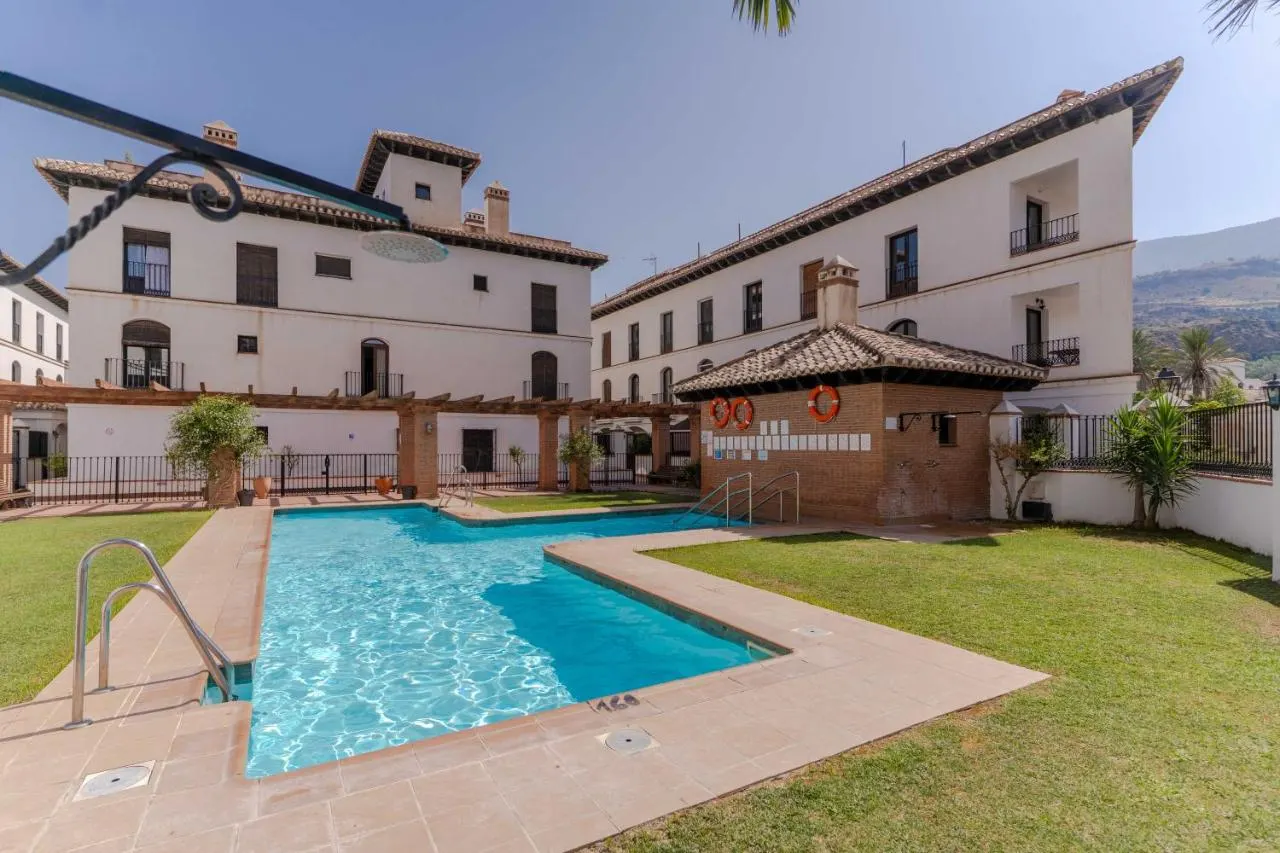
Rincón Salvaje is a two-bedroom duplex in Vélez de Benaudalla, inland in the Guadalfeo valley: a village base, not a seafront hotel. The stay page and the official listings say exactly what it offers.
- The Jardín Nazarí: a Nasrid garden in the village
- Granada and the Alhambra: tickets and the Generalife
- The Alpujarra villages: Poqueira gorge and beyond
- The stay: Rincón Salvaje in Vélez de Benaudalla
A village base between the coast and the mountains
Rincón Salvaje is a two-bedroom holiday duplex for up to 4 guests in Vélez de Benaudalla, operated by RentitSpain, with a seasonal pool open until 31 October. It is booked only through Airbnb and Booking.com.
- The stay: Rincón Salvaje in Vélez de Benaudalla
- Remote work in Andalusia: city, coast or village for a stay of several weeks
- Winter in southern Spain: official winter averages for the coast, Málaga and Granada
- Where to go in Andalusia: the regions compared before you choose a base
Frequently asked questions
Where can I find a quieter Andalusia near Granada and the sea?
Look for places with a concrete reason to be quieter: small inland villages such as Vélez de Benaudalla, the protected Alpujarra villages, Salobreña’s protected old town, the coves under the Maro-Cerro Gordo cliffs and the beaches east of Calahonda that Turespaña lists as isolated or low occupancy.
Is Vélez de Benaudalla a quiet base?
Quiet in the sense that it is not a resort: it is a working village of about 3,100 inhabitants, with everyday shops, bars and farm terraces, and no beach or nightlife scene. It is a lived-in village, not a silent retreat, and it is inland: the beaches are reached by car.
Are there quiet beaches on the Costa Tropical?
Some. Turespaña rates Cambriles as low occupancy and lists La Rijana, Calaiza and Barranco de Enmedio as isolated. Protected areas help, but are not always empty: Marina del Este, by the Punta de la Mona, is rated high occupancy.
Is the Costa Tropical less crowded than the Costa del Sol?
The Costa del Sol takes about a third of Andalusia’s tourism. How the Costa Tropical differs is set out, with sources, on our Costa Tropical vs Costa del Sol comparison page.
When is the best time to avoid crowds?
Outside July and August. The coast stays mild (Motril averages 17.6 °C highs in January) and autumn to winter is chirimoya season. In summer, go early and expect access rules at protected beaches such as Cantarriján.
Sources · Facts checked on 8 November 2026
- INE · Padrón municipal 2025, Vélez de Benaudalla 3,108 inhabitants (via Wikipedia)
- Diputación de Granada · Jardín Nazarí de Vélez de Benaudalla
- Alzada no. 103 (2011) · Jardín Nazarí estate
- Andalucía.org · Castillo de los Ulloa
- Ayuntamiento de Vélez de Benaudalla · Ruta de las Minas
- Ayuntamiento de Vélez de Benaudalla · Ruta la Haza del Señor
- MITECO · Sierra Nevada National Park, cultural values (Poqueira BIC)
- BOJA no. 135, 17 Jul 2017 · Salobreña historic quarter, BIC Conjunto Histórico (Decreto 120/2017)
- Junta de Andalucía · Decreto 6/2015, ZEC and Paraje Natural Acantilados de Maro-Cerro Gordo
- BOJA no. 106 (06/06/2017) · Cantarriján access road resolution
- Junta de Andalucía · ZEC ES6140016 Punta de la Mona
- BOJA no. 6 (10/01/2025) · Order of 7 January 2025, ZEC Punta de la Mona
- Junta de Andalucía · ZEC ES6140014 Calahonda-Castell de Ferro
- Turespaña (spain.info) · Playa Calaiza
- Turespaña (spain.info) · Playa Barranco de Enmedio
- Turespaña (spain.info) · Playa Los Berengueles
- Turespaña (spain.info) · Playa La Rijana
- Turespaña (spain.info) · Playa Cambriles
- BOJA no. 49, 2009 · Charca de Suárez, Reserva Natural Concertada
- Ayuntamiento de Motril · Charca de Suárez, opening and visits
- Wikipedia · Costa del Sol (about a third of Andalusia’s tourism)
- Wikipedia · Motril, climate 1981–2010 (WMO)
- Motril Turismo · Municipal market
- BOE · Orden APA/3120/2002, DOP Chirimoya de la Costa Tropical de Granada-Málaga
- Infoagro · DOP Chirimoya (harvest seasons)
- Motril Turismo · Quisquilla de Motril
- Mancomunidad de Municipios de la Costa Tropical · Vélez de Benaudalla
- Booking.com · Rincón Salvaje listing
- Patronato de la Alhambra y Generalife · official FAQ
- Turismo de Salobreña · Walking trails (walk early or at sunset in summer)